
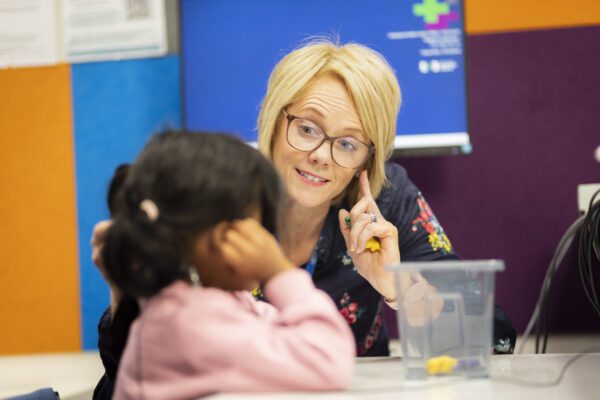
Did you know speech pathologists work at the Eye and Ear?
This Speech Pathology Week, we’re celebrating the important role they play at the Eye and Ear and in the wider community.
In line with this year’s theme, ‘Communication creates possibility’, we spoke with Lisa, one of our dedicated speech pathologists, about how speech pathologists support extends beyond helping people talk.
Who do Speech pathologist care for and what do they do?
Speech pathologists support people of all ages who experience difficulties with communication, speech, language, voice, social interaction and swallowing. We work across hospitals, community health and education services. Our support and advocacy can help people to more actively build social connections, participate in work, education and often everyday life.
Tell us something interesting about your role?
I’m lucky to be working in a specialised multidisciplinary team with very experienced Audiologists and ENT surgeons in the cochlear implant clinic. As a speech pathologist, I contribute to the assessment processes and help families to navigate the procedures to determine if a cochlear implant might be a suitable option for their child’s hearing needs. For children who do proceed, the speech pathologists educate families on ways to build their child’s new skills for listening, an often underestimated but essential foundation for the development of spoken speech and language.
What are some common misperceptions about Speech Pathology?
That our work only helps people to speak more clearly. Speech pathologists can be trained to support speech, language, voice, swallowing, fluency (stuttering), literacy and the use of alternative communication options.
What services to Speech Pathologists offer at the Eye and Ear?
We offer specialist assessment and communication services in the Cochlear Implant Clinic and within the multidisciplinary team in our Voice Clinic.
What are some things to expect during an appointment?
At the first appointment, the speech pathologist will take the time to get to know you, your child and understand your concerns. You should leave the session with a better understanding of how we can assist and a plan for any recommended next steps.
How can a patient access this support?
Discussion with your local hearing services and GP can assist to determine if our services are suitable for your needs.
What message would you give patients who might be hesitant to seek support?
Our approach is very patient centred. We aim to support patients and their families to feel well informed when making decision about their or their child’s communication needs and goals.
If a patient needs an interpreter, how do Speech Pathologist’s manage these appointments?
Speech pathologists work closely with professional interpreting services to ensure patients visual and spoken communication needs can be met.
What is your message to patients for Speech Pathology Week?
Speech pathologists work to help patients build their communication skills in way that are important to them. The ability to communicate is one of our most important aspects of life. As speech pathologists, we love to see people gain the confidence and opportunities that learning to communicate effectively can bring.